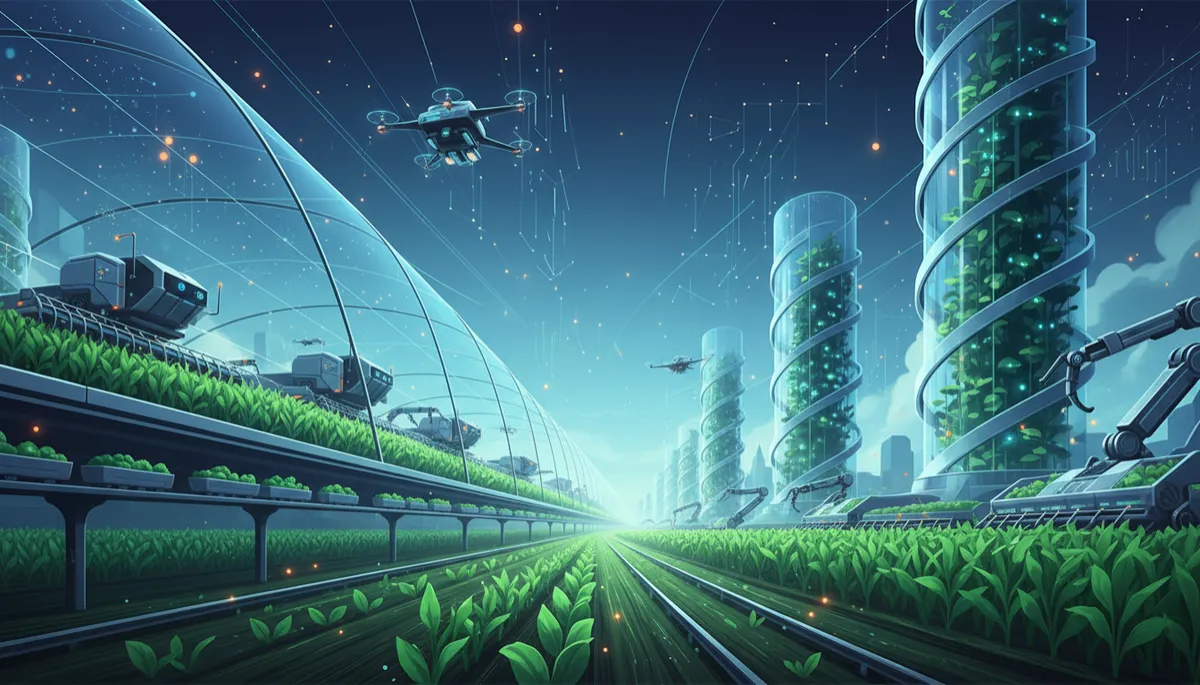
Farm Technology 2026: Trends Reshaping Agriculture
Agriculture, Industry News, Farm Technology 2026
Farm Technology in 2026: The Industry News and Trends Reshaping Agriculture
From AI “farm advisors” to laser-guided weeders and fertilizer-cutting robots, 2026 is a turning point for how farms operate, invest, and compete. Here’s a clear look at the biggest news and trends every grower, agribusiness, and rural stakeholder should know.
2026 at a Glance: From Gadgets to Connected Farm Ecosystems
The defining shift in 2026 is integration over isolated tools. Instead of buying one-off gadgets, farms are plugging into connected ecosystems that link AI, robotics, sensors, marketplaces, and traceability platforms. Industry analysts note that AI has moved from “nice-to-have dashboards” to prescriptive decision support that tells growers what to do, when, and why, using live data and years of field history (qaltivate.com).
AI Becomes a Farm Advisor, Not Just a Forecast Tool
In 2026, farm platforms increasingly behave like a knowledgeable agronomist on call 24/7. With generative AI built in, farmers can ask natural-language questions such as, “Which hybrid performed best on clay soil during last year’s drought?” and receive instant, data-backed recommendations (agnomy.com). These tools combine sensor data, satellite imagery, weather forecasts, and financial records to suggest specific actions—prioritizing irrigation, flagging disease risks, or recommending variable-rate inputs across fields.
Policy is racing to keep up. At the 2026 NASDA Winter Policy Conference, U.S. state agriculture officials called for closer collaboration between USDA, land‑grant universities, and public research institutions to accelerate responsible AI in agriculture (nasda.org). That signals long‑term public investment in AI tools tailored to real farm challenges, not just lab experiments.
Robotics and Autonomous Machinery: Doing More With Less Labor
Labor shortages and rising costs are driving rapid adoption of robotics. Self‑driving tractors, robotic weeders, and autonomous sprayers are no longer futuristic—they are working acres today, often through “robot‑as‑a‑service” models that lower upfront costs (qaltivate.com). Hybrid “human‑in‑the‑loop” workflows are common: robots handle repetitive passes, while people supervise, fine‑tune settings, and make strategic calls (globalagtechinitiative.com).
A standout 2026 news story is Upside Robotics, a Canadian startup that raised $7.5 million to scale its solar‑powered fertilizer robots into the U.S. Corn Belt. Their machines use real‑time soil and weather sensors to apply fertilizer only where and when needed, cutting usage by up to 70% and saving an estimated $150 per acre per season (fertilizer-summit.com). Having grown from 70 acres in 2024 to 1,200 in 2025, they’re targeting more than 3,000 acres in 2026—evidence that practical robotics is scaling quickly.
Weed control is also being transformed. Seattle‑based Carbon Robotics launched its LaserWeeder G2 platform, which uses AI trained on over 150 million labeled plant images to identify and destroy weeds with lasers. The new G2 is lighter, faster, and more modular, doubling acres treated per hour and extending into broad‑acre organic corn and soybeans—all without disturbing soil or relying on herbicides (farms.com).
Smarter Machines and Data‑Rich Operations
Major equipment makers are embedding intelligence into every pass across the field. CNH Industrial’s New Holland ForageCam™ won 2026 Farm Machine of the Year in the “Smart Farming & Robotics” category. Its AI‑powered cameras continuously analyze forage kernel processing and automatically adjust machine parameters to meet a farm’s Kernel Processing Score, boosting feed quality and consistency (cnh.com).
At the DeKalb International Farmers Market, the new 826 International Tractor and 715 International Combine showcased where mainstream machinery is headed. The 826 offers around 120 HP with automation and GPS guidance, covering up to 50 acres per day, while the combine uses AI and IoT sensors to cut grain loss by up to 15% through real‑time optimization (nationaltoday.com).
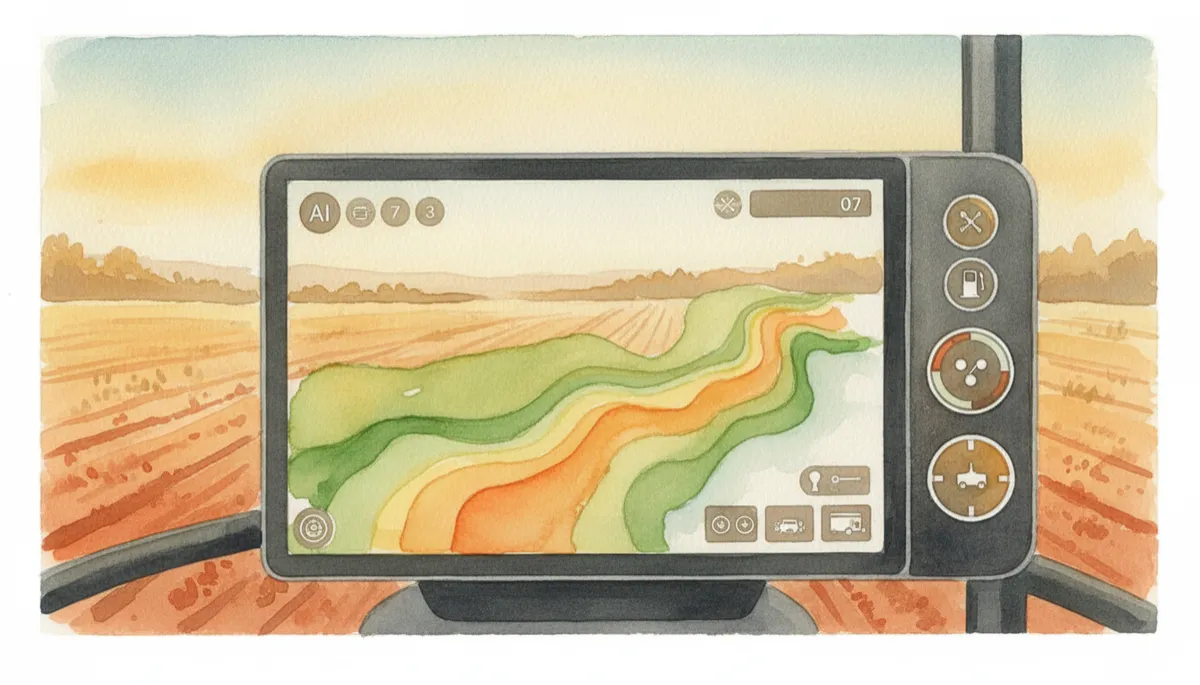
AI-ready machines now turn every field pass into actionable agronomic and financial data.
Connectivity, IoT Sensors and Unified Farm Analytics
Reliable connectivity—long a barrier for rural operations—is improving fast. Partnerships between satellite providers and equipment makers are enabling real‑time data flow between machines, sensors, and cloud platforms, even in remote regions (globalagtechinitiative.com; techradar.com). As a result, soil probes, weather stations, livestock monitors, and equipment trackers can all report live conditions into a single dashboard.
The industry is moving from simply collecting “big data” to delivering unified analytics. Modern farm management systems now blend agronomic, financial, and sustainability metrics, helping managers see how decisions on inputs, labor, and equipment affect both yields and margins across seasons (icl-group.com). Digital ecosystems increasingly combine input purchasing, grain sales, advisory services, transport, and even carbon credits in a single platform (qaltivate.com).
Sustainability, Carbon Farming and Climate Resilience Go Mainstream
In 2026, sustainability is no longer a side project—it is a core business strategy. Farmers are using digital MRV (Measurement, Reporting, Verification) platforms and AI models to forecast soil carbon sequestration and estimate revenue from carbon credits (qaltivate.com). Climate‑smart tools, from smart shading and biostimulants to controlled‑release fertilizers, are helping protect crops from heat, salinity, and drought (icl-group.com).
New inputs and practices are gaining traction, including biochar from pyrolysis, microbial soil enhancers, and highly efficient irrigation systems that cut water use by 20–40% (agtechnavigator.com; farmonaut.com). At the same time, CRISPR‑enabled crop varieties and advanced biofertilizers are reducing chemical dependence by as much as 40% while improving resilience (startus-insights.com).
Traceability, Blockchain and Transparent Supply Chains
With global buyers demanding proof of origin and sustainability, traceability is rapidly becoming mandatory. By 2026, more than half of global agricultural trade is projected to require digital traceability systems (gov.capital). Blockchain‑backed records are being integrated into farm platforms to support food safety certifications, finance, carbon claims, and consumer‑facing labels (farmonaut.com).
Indoor, Vertical and Renewable‑Powered Farming
Soilless and controlled‑environment systems—hydroponics, aeroponics, and vertical farms—are expanding, especially near cities and in regions with volatile climates. Automated greenhouses, guided by IoT sensors and AI, fine‑tune light, humidity, nutrients, and biosecurity to deliver high yields with fewer inputs (farmonaut.com). At the same time, agrivoltaics projects combine solar panels with crop production, creating dual revenue streams from energy and food (Wikipedia).
Who Is Adopting These Technologies? Younger Farmers Lead the Charge
Adoption patterns are shifting as the next generation steps in. According to Bushel’s 2026 State of the Farm report, farmers under 50 now make up 38.4% of respondents in the U.S. and Canada, up from 28.8% the previous year. They strongly favor mobile‑first tools, AI‑powered business analysis, and digital grain marketing—over 31% of grain sales are now digital, and 56% of farmers use apps or software to sell grain (agfarmnews.com).
Drones are also lowering the barrier to entry. Research presented at a 2026 Canadian Agricultural Drone Association conference suggests young farmers can launch a drone‑based agribusiness for under $150,000, often earning back the investment after a single season (nationaltoday.com). Compared with million‑dollar aircraft, this is a much more accessible route into precision spraying, imaging, and custom application services.
💡 Key Takeaway: In 2026, the most competitive farms aren’t necessarily the biggest—they are the ones that connect data, automation, and sustainability into a single, well‑managed system.
Looking Ahead: How to Navigate Farm Technology in 2026 and Beyond
The 2026 landscape can feel overwhelming, but the underlying direction is clear. Technologies for farms are converging into smart, resilient, data‑driven systems where AI acts as a strategic partner, robots handle routine labor, sensors feed real‑time insights, and sustainability directly supports profitability. For most operations, the most practical path forward is to start with one or two high‑impact use cases—such as precision fertilizer application, autonomous weeding, or digital grain marketing—and then plug those tools into a broader, interoperable platform over time.
As 2026 unfolds, the farms that thrive will be those that treat technology not as a collection of gadgets, but as an integrated strategy for productivity, risk management, and long‑term resilience.
